When it comes to perimeter security, palisade fencing remains one of the most trusted solutions for commercial, industrial, and residential properties. Known for its strength, anti-climb design, and long service life, palisade fencing offers an excellent balance between security and visibility. Whether you want to protect a factory, school, warehouse, or private property, understanding the different types of palisade fencing can help you make the right investment.
Palisade fencing is a steel security fence made from vertical pales attached to horizontal rails and strong support posts. The fence is designed with pointed tops and narrow spacing to discourage climbing and unauthorized access. Because of its durable structure and intimidating appearance, it is widely used in high-security areas.
Modern palisade fences are usually manufactured from galvanized steel and may also include powder-coated finishes for improved corrosion resistance and aesthetics.
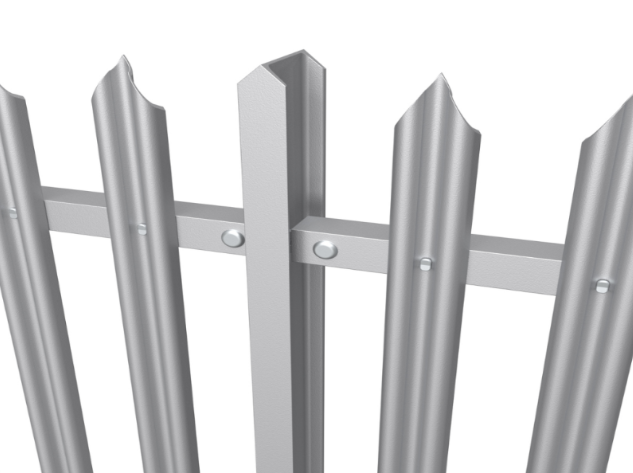
The two primary categories of palisade fencing are based on the shape of the steel pales: D section and W section.
D section palisade fencing features pales shaped like the letter “D.” This design provides a clean and decorative appearance while still maintaining strong security performance.
Smooth and attractive profile
Good rigidity and durability
Suitable for medium-security applications
Available in multiple thickness options
D section pales commonly come in:
3 mm for general-purpose security
3.5 mm for higher-security applications
4 mm for special or heavy-duty requirements
D section fencing is ideal for:
Residential complexes
Schools
Commercial buildings
Parks and recreational areas
Decorative perimeter fencing
Because of its cleaner appearance, D section fencing is often chosen where aesthetics matter alongside security.
W section fencing uses a corrugated pale shaped like the letter “W.” This design increases strength and impact resistance, making it the preferred choice for high-security environments.
Higher structural strength
Improved resistance to bending and vandalism
Excellent anti-climb protection
Strong visual deterrent
Typical W section thicknesses include:
2 mm for general use
2.5 mm for security purposes
3 mm for maximum protection
W section fencing is commonly used for:
Industrial facilities
Airports
Utility stations
Military zones
Railways and transport hubs
Warehouses and logistics centers
Many security professionals recommend W section pales with triple-point tops for sites requiring enhanced protection.
Palisade fencing can also be categorized by the design of the pale tops. These variations influence both security level and appearance.
This is the most secure option. The sharp points create a strong anti-climb barrier and intimidating appearance.
Offers moderate security while maintaining a simpler design.
Designed for areas where safety and appearance are more important than maximum security.
Provides a clean and modern look suitable for decorative applications.
Combines aesthetics with moderate security enhancement.
The ideal fence specification depends on your property type and security requirements.
| Property Type | Recommended Fence Type | Suggested Height |
|---|---|---|
| Residential property | D section | 1.2 m – 1.8 m |
| School or park | D section or light W section | 1.8 m – 2.1 m |
| Commercial property | W section | 2.1 m – 2.4 m |
| Industrial or high-security site | Heavy-duty W section | 2.4 m – 3.0 m |
Industry-standard panel widths are commonly around 2.75 meters, which helps simplify installation and maintenance.
Palisade fences are available with several protective finishes:
Hot-dip galvanized
Powder-coated
PVC-coated
Popular colors include:
Green
Black
White
Blue
Red
Powder coating not only improves appearance but also increases resistance to rust and weather exposure.
Palisade fencing continues to grow in popularity because of several important benefits:
High level of security
Excellent anti-climb protection
Long service life
Strong resistance to vandalism
Easy installation and maintenance
Clear visibility for surveillance systems
Suitable for uneven terrain
Before selecting a fence, consider the following factors:
High-risk areas should use W section pales with triple-point tops and thicker steel.
D section fencing is often more affordable while still offering reliable protection.
For residential or commercial projects, decorative finishes and rounded tops may create a more attractive perimeter.
Choose galvanized or powder-coated fencing for areas exposed to moisture, rain, or coastal environments.
Steel palisade fencing generally requires minimal maintenance compared to wooden fencing alternatives.
Palisade fencing is one of the most effective perimeter security solutions available today. Both D section and W section fences provide excellent durability and protection, but the right choice depends on your property's security level, budget, and visual preferences.
If you need a decorative yet secure option, D section fencing is an excellent choice. For maximum protection and anti-vandal performance, W section palisade fencing remains the industry standard. By understanding the different pale profiles, top designs, and finishing options, property owners can confidently select a fencing system that delivers long-term value and security.
Latest Post